
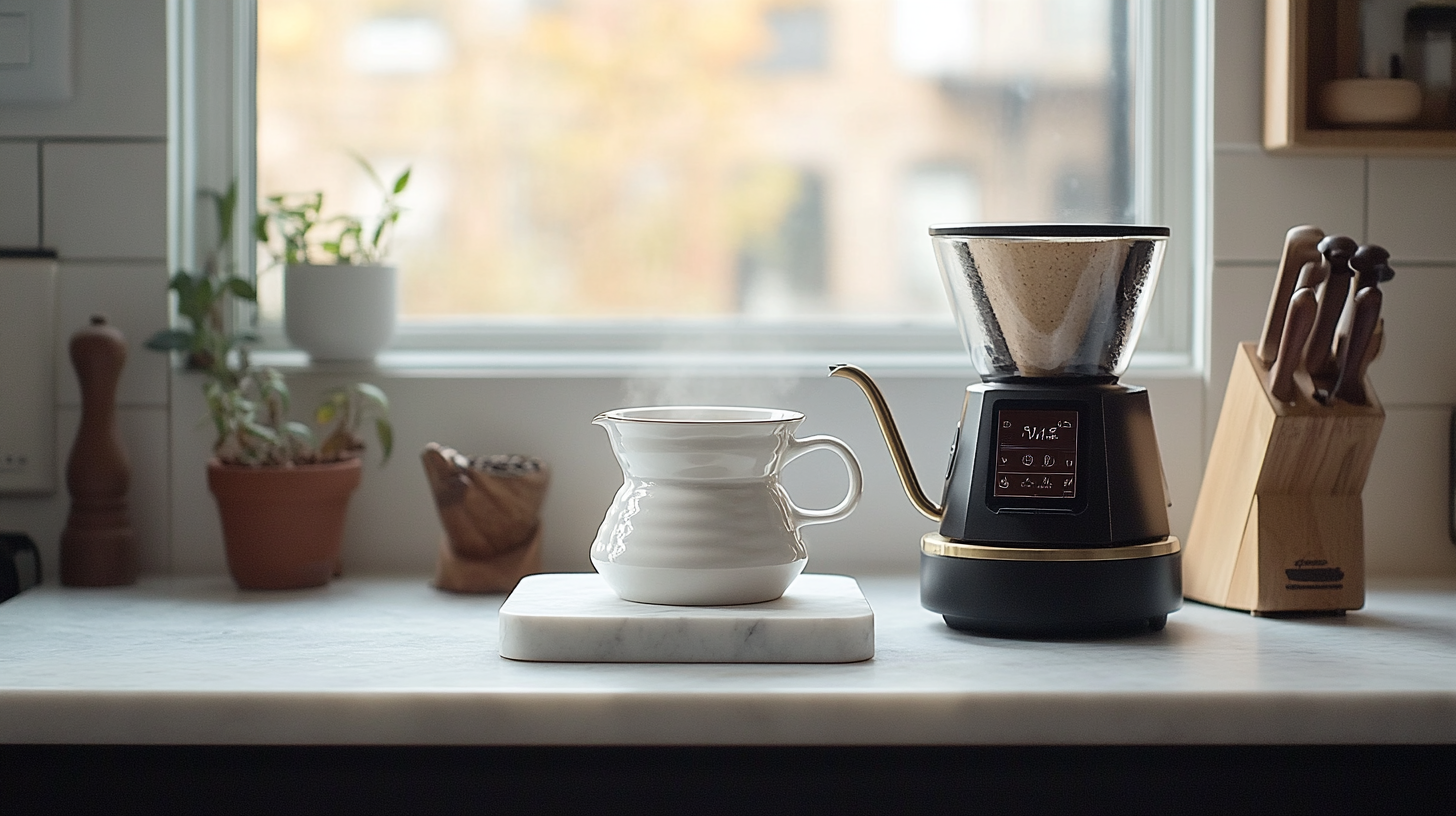
the drip machine has been sovereign since the second morning in the apartment. i set it up on february 9th, plugged it in, and it made coffee. i want to give it credit for that. it is reliable in a way that does not require my participation—it runs at 7am, produces something that is technically coffee, and asks nothing of me in return. julian uses it before i do and does not comment on the experience in any direction. in a managed-community kitchen, this is the least complicated arrangement you can have with an appliance. i have respected the arrangement.
but i have been ignoring what it’s cost me.
the drip machine takes up nine inches of counter and returns a quantity of hot liquid that will get you through the morning if you don’t think about it too hard. what it doesn’t return to you is a process. it begins. it ends. the involvement required on my part is zero. for the first two months this felt like a reasonable trade—the kitchen had more urgent problems, the apartment had more pressing grievances, and i was not ready to audit the coffee situation on top of everything else.
somewhere around week six i started actually looking at the counter. not cataloging what it lacked anymore, just looking at what was there. and what was there was a machine that solved a problem i’d stopped bringing any intention to. the pour-over has been the answer the whole time. i already knew this. i just hadn’t said it out loud.
what the pour-over requires is attention—water temperature, bloom time, the specific angle and pace of the pour, four minutes of standing at a counter doing one thing that can’t be run in the background. it is, to my knowledge, the only activity in this kitchen that is both completely manual and completely precise. julian asked once if i could “just start a timer on my phone” instead of watching the kettle’s lcd display. i didn’t know how to tell him that watching the number is the point. this is the brief on the three objects currently occupying the pour-over corner of the counter negotiation.
01. Hario V60 Ceramic Coffee Dripper 02 — the geometry of patience
the v60 is made in arita, japan, in a region that has been producing ceramics for four hundred years. i don’t think this matters practically—the ceramic is not four hundred years old—but it matters as a statement of intent. they chose the difficult material instead of the adequate one, and this is the kind of decision i have learned to respect in an object.
the geometry is precise: sixty-degree angle, a single large drainage hole at the bottom, and a spiral ribbing inside the cone that promotes airflow and lets the water flow at its own pace rather than pooling. size 02 handles up to four cups. it fits over a carafe, a mug, whatever has a rim wide enough to catch it. the ceramic retains heat differently than plastic—evenly, slowly, without the thermal contraction that plastic introduces when you pour boiling water through it. it weighs roughly five ounces. you could hold it in one hand, and it would feel like something that would outlast you.
julian watched me grind beans by hand the first morning i used all three pieces together and asked if i was “making jewelry.” in a way. the v60 is the part that would survive an estate sale.
shop: Hario V60 Ceramic Coffee Dripper 02 →
02. Fellow Stagg EKG Gooseneck Kettle — the precision instrument
the argument for a gooseneck kettle is simple and i resisted it for longer than i should have because it seemed like the kind of purchase that requires you to admit you care about coffee—specifically, that you care about it in a way that involves equipment and a learning curve and the possibility of being wrong. the argument is: you cannot pour from a standard kettle over a v60 dripper with any precision. you can try, but you will flood the grounds, collapse the bloom, and produce a cup that does not taste like what you were trying to make. the gooseneck is not an affectation. it is a functional requirement.
the fellow stagg ekg is 0.9 liters of 304 stainless steel. the lcd panel on the handle displays temperature to the exact degree and includes a built-in stopwatch—because bloom time is not a suggestion, it’s a variable. the hold mode maintains your target temperature for sixty minutes, which is useful on mornings when you start the process and then have to go do something else before you can finish it. the spout arc is curved specifically so that a slow, steady spiral pour over the grounds is possible without dexterity you haven’t developed yet. 1200 watts heats the water faster than i can get the grinder set up.
julian asked if the lcd display was “for the kettle or for the wifi.” neither. it’s for the bloom.
shop: Fellow Stagg EKG Gooseneck Kettle →
03. Timemore Chestnut C2 Hand Grinder — the mechanical reduction
i had a blade grinder for years. it was a violent object—it chopped the beans rather than cutting them, produced particles that varied enough in size to extract at different rates, and ran hot enough to introduce a faint oxidation note that i had been attributing to my taste preferences rather than to the machine. this is the kind of small technical compromise that compounds quietly over a decade. the c2 corrected it in the first use.
the timemore c2 is a hand-powered conical burr grinder with cnc-machined stainless steel burrs—the same cutting geometry used in commercial café equipment, at roughly fifty dollars. the double-bearing mechanism reduces wobble in the burr assembly, which means the grind particles land in a narrower size distribution. narrower distribution means more even extraction. more even extraction means the cup tastes like what the beans were supposed to taste like rather than like a compromise between the particles that extracted correctly and the particles that didn’t. it holds 25 grams—enough for a full v60 dose. it takes forty-five seconds to grind. those forty-five seconds are quiet and specific and require nothing else from you except the turning of the handle.
julian offered to hold the grinder steady while i turned it. he described this as “teamwork.” it was not teamwork. it was him wanting to be present for something he didn’t understand but could tell mattered. i let him help. the coffee was good.
shop: Timemore Chestnut C2 Hand Grinder →
the drip machine is still on the counter. it’s still julian’s coffee in the morning—fast, adequate, no ceremony required. i’m not arguing that the pour-over is more efficient, or that everyone should do it, or that the drip machine was the wrong call for the first two months when i didn’t have the bandwidth to introduce any new variables into this kitchen.
what i’m saying is that the apartment has been mostly built now, and what happens after the rescue mission is that you start choosing. you pick up the object that requires more from you and decide if you want to give it. the pour-over is four minutes, a kettle that tells you the temperature, and a ceramic cone that will outlast everything else on this counter by about three hundred years.
i give it. it turns out that’s what i was looking for all along in the morning.
products:
- Hario V60 Ceramic Coffee Dripper 02
- Fellow Stagg EKG Gooseneck Kettle
- Timemore Chestnut C2 Hand Grinder
price: $49.99–$179.00
why buy: because the drip machine is sovereign and you’ve been letting it
(affiliate links above — i make a small commission if you buy, which funds my ongoing counter negotiation with the managed ecosystem)
Leave a Reply