
i’ve been doing a room audit this week. monday was the inventory: the ceiling fan connected to nothing, the fitted sheet’s nightly migration, the placeholder lamp still holding its temporary position after forty-seven days. friday will be the answers. but there was one thing the audit surfaced that i didn’t put on the monday list, because it isn’t visible, and i have a documented pattern of ignoring things i can’t see.
the air.
i want to say upfront that i did not arrive at this by caring about air quality in the abstract. i am not a person who reads lifestyle content about toxins or opens a newsletter about the volatile organic compounds in scented candles. what i am is a person who bought an air purifier last week because the spring pollen counts started and the apartment windows are sealed and the HVAC system circulates air through a building where sixty-three other units are also producing whatever sixty-three other households produce, and at some point the math became impossible to avoid.
the apartment is a managed-community building with single-pane windows we have already established cannot be opened without triggering a conversation with the property management office. the floors are a synthetic laminate that photoreproduces wood grain. the carpeted hallway outside our door is, by any honest material assessment, a pollen trap with a runner. we moved in in february and have been breathing this air since february, and what the levoit told me in its first three hours of operation is that the air in the bedroom was consistently registering in the “fair” range on its sensor; not dangerous, not alarming, just quietly, persistently not the air you’d design if you were designing air.
i will explain what that means. first, the object.
levoit core 300s-p smart air purifier — the quality report
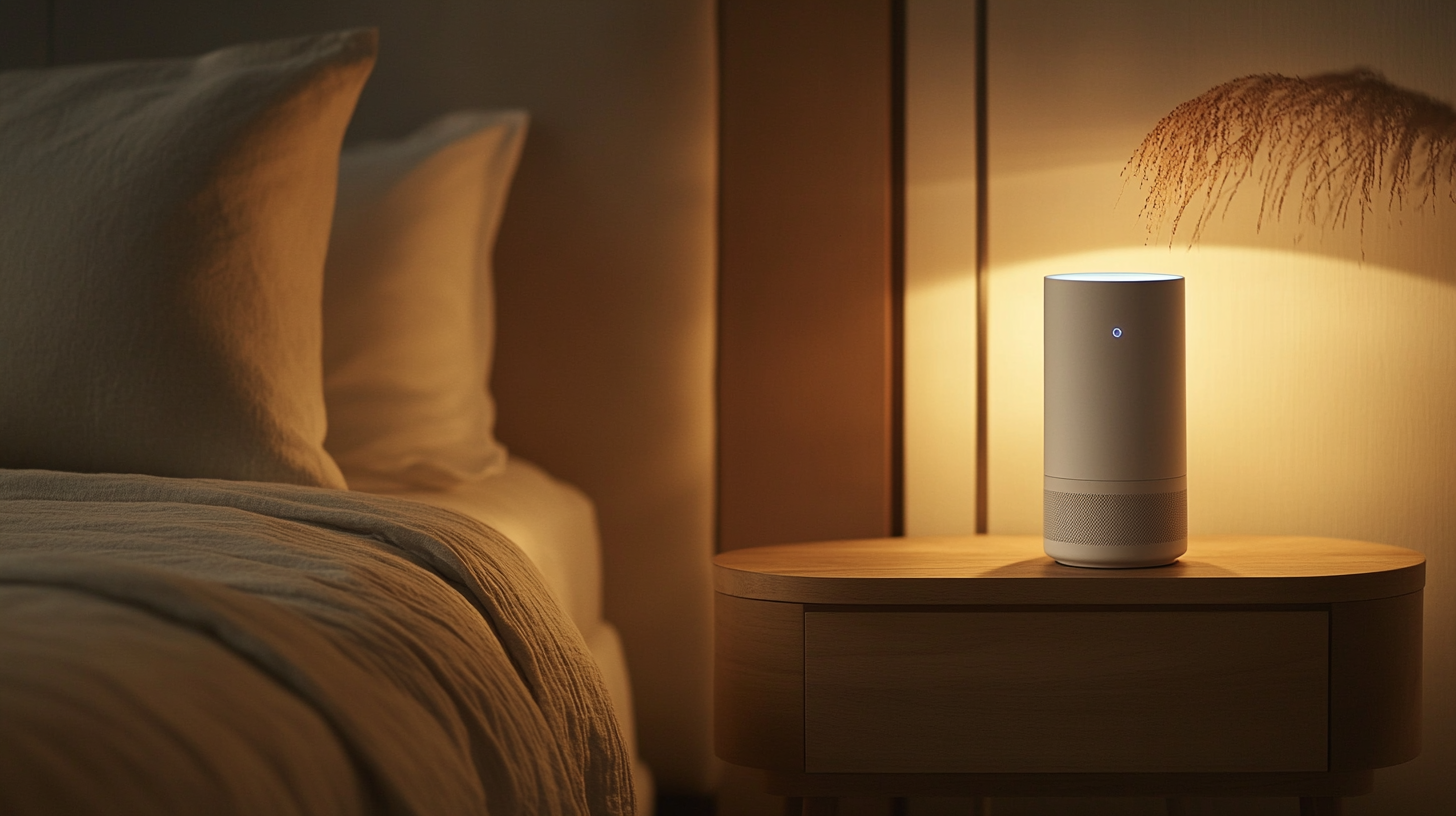
the 300s is an eight-inch cylinder (specifically, 8.7 inches tall and 6.9 inches in diameter) which means it has the footprint of a large candle and the visual authority of something that knows what it’s doing. it sits on the nightstand without claiming the nightstand. this matters more than it should to me, because the nightstand is already managing a lamp, a phone, and the dohm, and a device that announced itself as an appliance would have broken something in the arrangement.
the filtration is three stages. there is a nylon pre-filter that catches the visible things: hair, visible particulate, the ambient evidence of julian’s existence in the apartment. behind that is an HEPA-grade filter; not “true HEPA,” which is a marketing certification that has been the subject of enough industry disputes that i’ve decided to stop using the phrase and simply describe what it does, which is capture 99.97% of airborne particles at 0.3 microns. behind that is an activated carbon layer that addresses gases and odors rather than particles: the off-gassing from synthetic materials, the cooking smells that migrate from the kitchen at odd hours, the specific ambient scent of a building that was designed to be neutral and achieves instead the olfactory equivalent of a held breath.
the air moves through this stack via VortexAir technology, which is levoit’s name for a cylindrical 360-degree intake design — the purifier draws air from all sides simultaneously rather than from a single intake face, which means it works without needing to be oriented toward the problem. you don’t aim it. you place it, and it addresses the room.
at 22 decibels on sleep mode, it is quieter than the dohm, which is itself already quieter than the refrigerator. i ran both last night simultaneously (the dohm generating its mechanical broadband and the 300s running its sleep cycle) and the result was a room with a consistent, layered interior weather that had no single identifiable source. the apartment stopped sounding like an appliance and started sounding like a place.
the sensor is the thing i keep returning to. there is a small LED ring at the top of the unit that displays real-time air quality in four colors: blue for good, green for moderate, yellow for poor, red for very poor. the first night i ran it, the ring started yellow. it moved to green over the course of forty minutes and settled at blue after about an hour. i watched this happen from the bed while julian slept through the entire diagnostic. i don’t know what i was expecting. i think i was expecting it to go straight to blue, the way you expect a room to pass a test you’ve decided it should pass. it didn’t. it earned blue.
julian asked, the next morning, if the little light was always going to be on. i told him it was currently blue, which meant the air was good, which meant the question he should be asking was what color it was before i turned it on. he made the face. he went to make coffee. by the time he came back it was still blue. i consider this a win on multiple fronts.
the 300s connects to the VeSync app, which is the same ecosystem as the smart bulbs already running in this apartment, which means the air quality data, the schedule, the fan speed, and the filter life all live in the same app as the kelvin rating on the overhead. i find this either convenient or mildly unsettling depending on the hour. the app tracks your air quality history over time, which means i now have a graph of what this bedroom has been doing since thursday, and the graph confirms what the sensor already told me: the air improves consistently when the purifier runs and deteriorates when it doesn’t, particularly overnight when the building’s HVAC system is cycling on its own schedule.
the filter replacement is every six to eight months, depending on usage. replacement filters are around $19.99, which is the kind of number that resolves the math quickly: the ongoing cost of operating this device is roughly $30 a year for clean air in the room where i spend a third of my life. the alternative is the status quo, which the sensor has now characterized for me in a color.
i’ve been addressing this bedroom in stages: the textiles on monday, everything else on friday. this is the one that doesn’t photograph. it doesn’t appear in a styled flat lay or catch light in a way that reads as intentional on a screen. it just runs at 22 decibels and turns the ring blue and removes the things i’ve been breathing without knowing i was breathing them.
that turns out to be the point.
shop: levoit core 300s-p smart air purifier
product:
price: $149.99
why buy: the sensor started yellow. it took forty minutes to reach blue. you were also in a yellow room.
(affiliate link above — i make a small commission if you buy, which funds my ongoing investigation into things in this apartment that are quietly not fine.)
Leave a Reply