
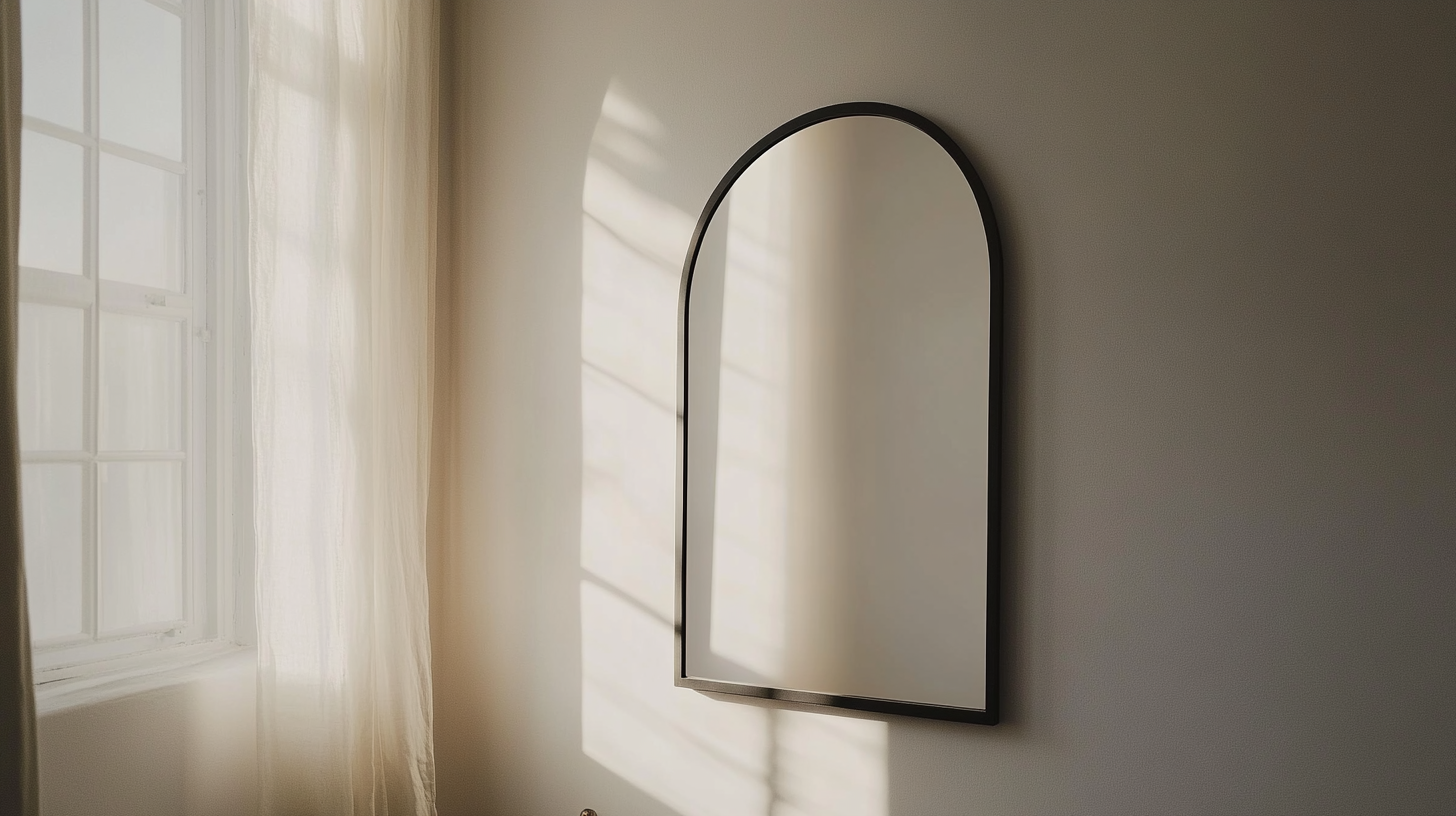
the box arrived on wednesday. it was larger than i’d anticipated—which is always the way with mirrors, objects that exist in their digital catalog images as confident, well-proportioned things and arrive in your foyer as an indictment of spatial planning. julian had to hold the door. we stood in the foyer for a moment, the box and us, regarding each other.
the thing i hadn’t fully processed, during the six weeks of research and measuring and deliberation, is that ordering the mirror was the intellectual commitment and opening the box was the physical one. you can unmake a decision in your head. you cannot return a 36-inch mirror after you’ve taken it out of the packaging, assessed its weight, and run your thumb along the arch curve to confirm the powder coat is what it looked like in the photos. i did all of this within approximately four minutes. the mirror was real. it had arrived. it was going on the wall or it was going in the closet, and putting it in the closet would be the most expensive and most accurate portrait of who i used to be before i decided to be different.
julian said, “okay, so where’s the stud finder.”
here is the thing i did not anticipate: the emotional weight of the nail.
i’ve owned things. i’ve hung things. i have, in previous apartments, put art on walls with a casualness that was native to someone who’d chosen her own address, in a neighborhood she’d lived in for a decade, in a city where she understood her coordinates. but this apartment i did not choose. the move was julian’s, the contract is julian’s, the gray vinyl driftwood flooring was selected by a property management company in consultation with no one and i arrived to find it already there. for two months i’ve been building around a space that isn’t quite mine—adding lamps, stoneware, throw blankets, cast iron—objects that sit on surfaces and can be relocated without leaving evidence. objects that say: i’m here for now, but i haven’t decided yet.
a nail in the wall is different. a nail in the wall leaves a hole.
julian found the stud on the first try (he’s good at structural things; it’s one of his qualities i’ve stopped pretending not to appreciate) and drew a small pencil mark at the agreed height. 44 inches from the floor—i’d calculated this in advance, the midpoint of the wall section accounting for the mirror’s 36-inch drop. everything was ready. the nail was a finish nail, 1.5 inches, appropriate for the anchor weight. the hammer was in my hand. there was nothing left to do.
i thought, briefly: if i don’t put this nail in the wall, i still technically haven’t committed to being here.
i put the nail in the wall.
the arch is 24 inches wide and 36 inches tall. powder-coated matte black—not glossy, not chalky, but the specific in-between of a surface that’s been properly cured. the glass is tempered and clear enough that it actually functions as a mirror, which means it pulls the afternoon light from the window across the room and places it somewhere new—at head height, in the section of wall that was previously just more wall.
what it does to the room is quieter than i expected. i’d described it in the research post as “a formal decision”—as something that implies load-bearing, something above it requiring support. what it actually does in the room is less dramatic than that, and more useful. the arch creates a second vertical in the space: a focal point where the eye lands and rests instead of traveling the length of uninterrupted white. the black frame gives the room an edge it didn’t have before. a hard contrast that says: this is the kind of room that has made a decision.
the wall still has a lot of wall in it. the shelves are a pending decision, the botanical prints are a hypothesis, the pampas question is unresolved. but the first thing is up, and the first thing changed the room’s relationship to itself—made it legible, in a way it wasn’t before. made it possible to see where the rest might go, now that there’s something to organize around.
julian looked at it for a moment and said, without prompting, “it looks like it belongs there.”
i said, “that’s the idea.”
he said, “no, i mean it looks like it’s always been there.”
i didn’t have anything to add to that, because it was—unexpectedly, without warning, while i was standing in a managed-community apartment i didn’t choose—exactly what i’d wanted to hear.
there’s a thing i’ve been thinking about since wednesday evening, since the nail went in and the mirror went up and julian and i stood back and looked at the wall together for the first time and found it changed.
i trained for a decade as someone who builds environments for other people. i understand, on a technical level, how objects relate to space—how to read a room, diagnose what it needs, make a place feel like somewhere rather than nowhere. i know how to do this professionally. and yet i’ve been in this apartment for two months and the first permanent mark required six weeks of deliberation and a moment of hesitation with a hammer that i’m still a little embarrassed about.
what i’ve figured out, standing on the other side of that moment, is that there’s a difference between knowing how space works and accepting that this is the space you’re working in.
the blank wall was a posture. a refusal to fully claim the room because claiming the room means acknowledging you’re in it—that you’re not still deciding, that this is the place, that when you put something here you’re putting it here and not somewhere else you’d rather be. i could bring in all the objects i wanted—the cast iron, the arched floor lamp, the correct temperature of light—and still maintain, technically, that i hadn’t decided. the wall was the last honest surface. the last place i hadn’t committed to.
the nail is in now. the arch is up. the room is being claimed, not just inhabited.
i live here now. the wall says so.
Leave a Reply